
Wednesday, July 8, 2015

Episode 051: Vector Components Wrap-Up and Release Party!


Download this episode (right click and save)


The wonderful day is finally here! We've come a long way and are finally finished with the notion of taking a vector and breaking it into components which align with our coordinate axis, a key tool to succeeding in physics. To provide a wrap-up, I would like to give you a walk through of the new pwn physics: vector components app now available in the Apple App Store. Included below are several screenshots from the app to give a visual aid to this guided tour. First, I took a screen shot of my home screen from my iPhone, which has some older apps, some unreleased (!) apps, and the vector components app which is of interest to us. You are brought to a welcome screen where I have a few words about the real importance of this technique on your journey as a physicist. Next we move to the menu where all in-app navigation takes place.

At this point let's take a look back at the steps for breaking and recombining vectors and their components. There are 5 steps for each of these. In the pwn physics: vector components app, we break down each step for breaking a vector into components.

Next, with tools in hand we must test our grasp of the knowledge, provided are four examples, one a kinematics, two from force, and the third a challenge, try and reverse the steps to recombine into the original vector. Kinematics and Force are two huge subsections of introductory physics. They are also a great playing field to see these techniques in action.


As a reference, provided is a section with some vector jargon which gets thrown around in the app rather comfortably. These are vector, vector component, and coordinate axis. Without these the uninitiated reader may get lost. They also embody the three critical elements of what is trying to be achieved in the problem: Identify a Coordinate Axis, Identify a Vector, Calculate the Vector Components.

Finally, as you press forward having learned and hopefully mastered this key concept, you may need a quick brush up in the future. We have you covered here as well. Included is a quick 12 flash-card review of questions which make you identify key concepts visually and via vocabulary. Throwing this into your last-minute review before a test will bring the information to the front of your mind and make sure that it is fresh and ready to use.

So, that is a quick tour of the Vector Components app, and will serve to wrap up the section. Be sure to check out the app in the store by clicking the link at the top or bottom of the page. Good luck!


Monday, June 29, 2015

Episode 050: Just Around The Riverbend...


Download this episode (right click and save)


So, to conclude our cliffhanger episode last time, here are my notes to accompany the podcast and address the questions how far down the river did our rower go, as well as how long did he traverse? Answers on the inside.

I think that it's obvious that to attack this type of problem you need to understand both vector components and sohcahtoa. If you haven't yet, I encourage you to check out the apps from the app list above. Good luck!

Thursday, June 25, 2015

Episode 049: Furthur Down The River....


Download this episode (right click and save)


This is the question from Episode #48, which we were able to solve, with relatively sweating. Now, in the coming days, I have a little homework assignment for you. School may be over, but you are not off the hook.

1) If the river is 20m wide, how far down the river does our rower travel?

2) How long does his traverse take?

Answers forthcoming. In the meantime, click below for the not so subtle musical clip of the week!


Tuesday, June 23, 2015

Episode 048: Vector Components #4- A Boat Down The River!


Download this episode (right click and save)


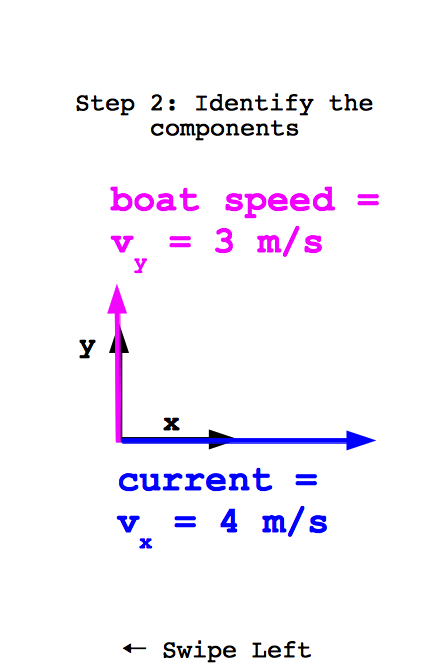
Question: A boat is moving across a river with a speed of 3 m/s. The river current is traveling at 4 m/s. What is the magnitude and angle of the boat’s total velocity? This type of problem usually has a lone rower trying to row his boat directly across the river. However, the current moving pushing downstream causes him to move at an angle! Sometimes they ask you to calculate how far downstream he will be based on the velocity and width of the river, but being able to combine these components into the total velocity vector is very important. In the next five steps we’ll be able to see exactly how to do that.

Step 1: Identify the coordinate axis and draw it on the paper. Free to choose, as always, we will align our coordinate axis with the two component vectors in our problem, i.e. the river current and the rower of the boat. Thus, we have our rather standard cartesian coordinate axis with the x-direction pointing to the right and the y-axis pointing upwards.

Step 2: Identify the components. In this problem we’re even given numerical values: the current is traveling along the x-direction at 4 m/s, and the boat is traveling in the positive y-direction at 3 m/s.

Step 3: Use the Pythagorean Theorem to calculate magnitude. Considering the x and y components to be legs of a right triangle, we’re able to calculate the magnitude of our vector, i.e. the resulting hypotenuse, via the Pythagorean Theorem. In the problem we’re conveniently given some perfect squares that calculate nicely to give us a velocity of 5 m/s.

Step 4: Use arctangent to calculate the angle. Since we’re going to be reconstruction the vector, this will always be the hypotenuse of the triangle. Ergo, we will always be using arctangent to calculate the angle, since the components will be the opposite and adjacent sides. In this example, the x-component can be considered the adjacent side, aka the current of the river and y-component or the boat speed can be considered the opposite side. Arctan(.75) is equal to 0.64 rad. Remember, if you see and angle smaller than 5 degrees, do a little mental math and check if you’re in radians or degrees mode. Your answer will look very silly if you wrote 0.64 degrees!

Step 5: Box your answer, you’re done! So, we have a boat which is ultimately traveling 36.86 degrees w/r/t the direction of the river, at a total speed of 5 m/s, with the help of the stream and our crazy boat rower. This mean’s he’s going about 11 mi/hr across the river. Not bad!

Sunday, June 21, 2015

Episode 047: 10 Summer Solstice Facts!


Download this episode (right click and save)


It's that time of year again. The first day of summer. The Summer Solstice. Many of us hear that phrase thrown around twice a year, for the summer and winter solstices, but what is it really? Here are 10 facts about the summer solstice:

1) How the solstice got its name- The name is derived from the latin- Sol means sun, and sistere means to stand still.

2) Summer Solstice marks the first day of summer.

3) Summer Solstice is when the earth's axis points closest to the sun.- The earths axis goes through the north and south poles. However, that axis does "point" straight up and down with respect to the sun. It is tilted slightly, 23 degrees from "straight up". As the earth moves around the sun, this angle remains the same, so for half of the year the northern hemisphere is directed moreso towards the sun, while for half the year the southern hemisphere is directed closer to the sun.

4) Summer solstice is the longest day of the year- Because the axis points closest to the sun, this is the maximum amount of time the sun remains in the sky, giving the longest day of the year.

5) The summer solstice in the north is the winter solstice in the south- The longest day of the year in the north is the shortest day of the year in the southern hemisphere. This also corresponds to the first day of winter, or winter solstice, for our friends down south.

6) Some places the day is so long it never ends!- In the far north, places like northern Alaska, the earth is directed at the sun such that the sun never sets, or it looks like sunset for a few hours before the sun rises again for weeks or months on end!

7) The solstice occurs somewhere between June 20-22- The solstice most commonly occurs on June 20 or 21, and this year it fell on June 21. The next June 22 solstice will occur in 2203!

8) During the northern hemisphere summer solstice, the earth is at its furthest point from the sun. During the winter, the earth is actually at its closest point, however the north is at this time directed away from the sun. This comes from the fact that Earth's orbit around the sun is not circular, but rather elliptical.

9) Stonehenge aligns with the sun during the solstice- Noone quite knows what stonehenge was designed for, but the symmetry of the monument is clear during the summer solstice- the sun shines directly on the heel stone during the sunrise of the solstice. Other theories regarding Stonehenge's purpose include a calendar, much like a sundial; a predictor of eclipses; an ancient burial ground; and a place of pagan worship.

10) 23,000 people turned out for the stonehenge sunrise this year- Down from 36,000 last year, thousands still go to hang out at stonehenge for the summer solstice and celebrate the longest day of the year.

Monday, June 15, 2015

Episode 046: Vector Components Example #3- Box Pulling A Rope!


Download this episode (right click and save)


This problem, surprisingly, is very similar to example #2. It’s a force problem, and you’re given a force vector which you need to break into components. The major difference in this problem is that we’re given actual numeric values instead of variables. You will find out that all of these problems are really just the same person with different faces, as we press through the next example. Notice that the steps don’t really change, and that the answer is very easily acquired by simply following the steps.

Step 1: Identify your coordinate axis and draw it on the paper. Because the force that we’re looking for is horizontal component of the pulling force, we want to align our x-axis horizontally. If you’re having trouble determining how to align your axis, this will come easier as you do more problems. Running down false alleys and seeing how the problem may not work out nicely will help give you a better sense of how to orient your coordinate axis in the future. The very nice and important thing to remember is that no matter which axis you choose the final answer has to be the same. It will not change based on your selection in this step. However, the math to achieve it may be messier or cleaner, which will improve based on your expertise.

Step 2: Identify your vector and draw it on the paper. In the problem the rope is being pulled upwards with respect to the x-axis, so we can guestimate the direction that it’s pointed like so.

Step 3: Identify your angle and draw it on the paper. This is given to us in the problem, so the only thing left to do at this point is draw it where it goes.

Step 4: Use sine & cosine relationships for component definition. In this scenario, because of the position of the angle, our x-component will be the adjacent side, and the vector our hypotenuse. This means we’ll be able to use cosine to calculate the horizontal component of the force. This will be the amount that directly opposes the frictional force, when you drag the box across the floor. This is why this force is of interest to us. We’ll also just calculate the y-component for fun. Remember, when you calculate the sin/cos(35), remember that this is 35 DEGREES, or else you’ll have to convert to radians!

Step 5: Box your answer, you’re done! So, a box being pulled 35 degrees w/r/t the horizontal will pull with 8.91 Newtons of force in the x-direction and 5.74 Newtons in the y-direction. So, are you getting the feel for it yet? Do you see how these problems are all basically asking the same question even though the scenarios are all different? If not, go back and refresh the last few examples to see if you see the similarities now.